 Camfident
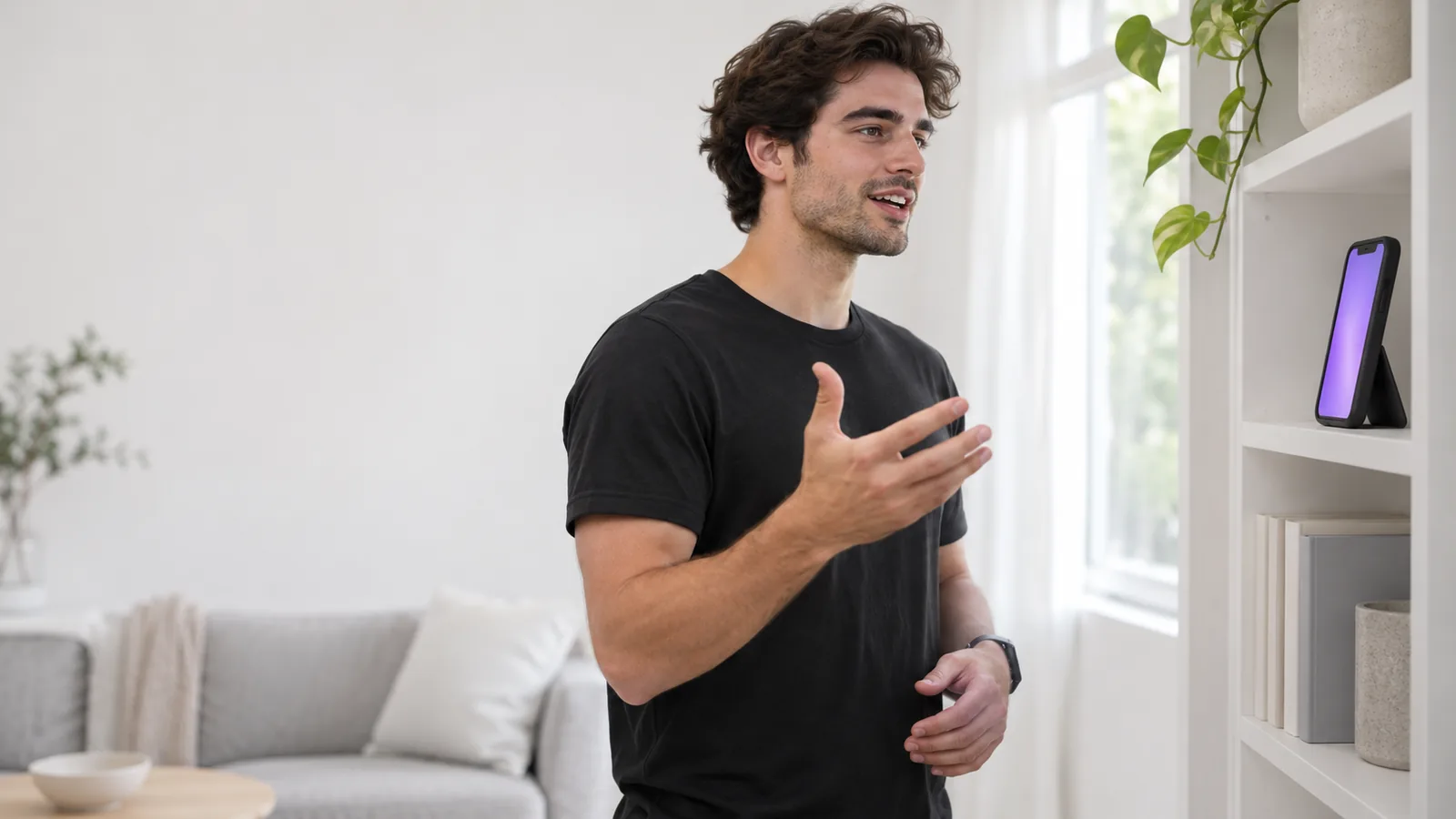
To practise public speaking alone at home, perform short, focused daily drills that isolate specific vocal and physical delivery skills. Record 1- to 3-minute practice sessions on your smartphone, review them objectively using targeted checklists, and rehearse structured frameworks rather than memorizing entire scripts.
Public speaking is an athletic skill requiring coordination between your respiratory system, vocal cords, facial muscles, and working memory. Rehearsing alone in a private, low-stakes environment allows you to experiment, make mistakes, and build muscle memory without social performance anxiety.
Solo speaking drills directly build the composure you need for high-stakes presentations, remote meetings, and camera communication. To understand the foundational mindset needed before tackling vocal drills, review our core guide on how to get over your fear of being on camera.
Why solo practice accelerates speaking confidence
Rehearsing alone accelerates your speaking progress because it provides an emotionally safe laboratory for progressive desensitization. When an audience is watching you, your cognitive bandwidth is occupied by monitoring their reactions, leaving zero mental space to adjust your breathing or vocal pace.
When you practice in an empty room, you remove social evaluation threat. You can stop mid-sentence, repeat a tricky phrase three times, or exaggerate your pauses without feeling self-conscious.
Furthermore, recording your solo practice gives you objective feedback that human listeners rarely provide. Friends and colleagues might tell you "you did great" to be polite, but a video recording accurately reveals your actual words per minute, vocal fillers, and eye movements.
8 solo speaking exercises you can do in 5 minutes
Incorporate these eight targeted drills into your daily routine. Each exercise targets a distinct physiological or cognitive component of effective communication.
- The 60-Second Impromptu Topic: - What to do: Pick a random household object (e.g., a coffee mug, your keys, a window) and speak continuously about it for 60 seconds without stopping. - Time: 2 minutes (1 minute prep, 1 minute speaking). - What it improves: Eliminates mental freezing and builds fluid spontaneous thinking.
- The Exaggerated Punctuation Drill: - What to do: Read an article paragraph aloud, inserting a full two-second silent pause at every period and comma. - Time: 3 minutes. - What it improves: Breaks the habit of rushing and reinforces our guide on how to use pauses when speaking on camera.
- The Silent-Lip Filler Purge: - What to do: Speak for two minutes on your favorite hobby. Every time you need to think of a word, firmly press your lips together and breathe through your nose until the thought forms. - Time: 3 minutes. - What it improves: Directly reduces vocalized fillers as outlined in our step-by-step tutorial on how to stop saying um and uh.
- The Pace Calibration Drill: - What to do: Count the words in a 150-word text passage. Set a stopwatch and read it aloud, timing yourself so you finish in exactly 60 seconds. - Time: 4 minutes. - What it improves: Trains your internal clock to hit an optimal conversational tempo, detailed in our breakdown of good speaking pace in words per minute.
- The Wall-Posture Projection Drill: - What to do: Stand with your heels, shoulder blades, and back of your head resting flat against a wall. Place your hands on your diaphragm and speak a short speech at conversational volume. - Time: 3 minutes. - What it improves: Opens respiratory capacity and anchors physical posture, preventing nervous slouching.
- The Story Spine Framework: - What to do: Practice the classic narrative arc: "Once upon a time... Every day... Until one day... Because of that... Until finally..." Fill in the blanks with a personal work experience. - Time: 5 minutes. - What it improves: Builds instinctive narrative structure so you can explain complex ideas logically.
- The Silent Visual Rehearsal: - What to do: Sit quietly with your eyes closed and mentally walk through the first two minutes of your upcoming presentation. Picture yourself breathing calmly, making warm eye contact, and speaking with steady composure. - Time: 3 minutes. - What it improves: A large review of mental-practice studies found that rehearsing a task in your head reliably improves performance, although not as much as practicing it for real.
- The Mock Video Interview Drill: - What to do: Record yourself answering common behavioral questions like "Tell me about a time you resolved a conflict" using the STAR method (Situation, Task, Action, Result). - Time: 5 minutes. - What it improves: Sharpens concise executive communication, which you can explore in depth in our guide on preparing for a video job interview when nervous.
If you want immediate feedback during solo practice sessions, Camfident gives you objective numbers after each take. The app analyzes your speech directly on your iPhone, measuring your speaking cadence, counting filler words, and tracking pauses without sending your recordings to external servers.
A weekly home practice schedule
Consistency matters far more than session duration. Dedicating ten minutes every day produces vastly superior results compared to an exhausting two-hour cram session once a month.
| Day | Primary Focus | Exercise Combination | Total Duration |
|---|---|---|---|
| Monday | Spontaneous Thinking | Impromptu Topic + Story Spine | 7 minutes |
| Tuesday | Pacing & Cadence | Pace Calibration Drill + Exaggerated Punctuation | 7 minutes |
| Wednesday | Filler Reduction | Silent-Lip Filler Purge + 60-Second Video Take | 8 minutes |
| Thursday | Posture & Projection | Wall-Posture Drill + Vocal Warm-Up | 6 minutes |
| Friday | Professional Simulation | Mock Video Interview Drill | 8 minutes |
| Weekend | Review & Reflection | Review best take of the week; note one improvement | 5 minutes |
What to look for when watching your recorded practice
Watching yourself on video can trigger initial cringing, but shifting from emotional self-judgment to clinical analysis makes the review process productive.
Evaluate your recording in three distinct passes:
- Pass 1 (Audio only): Turn your phone screen face down and listen strictly to the audio. Is your volume clear? Did you rush at the end of sentences? How many filler words did you count?
- Pass 2 (Video with sound muted): Turn off the sound and watch only the video. Are your hands moving comfortably within the frame? Are your shoulders relaxed? Did you look toward the lens or stare at the bottom edge?
- Pass 3 (Holistic review): Watch the full video once. Identify exactly one specific habit to refine during tomorrow's session.
Frequently Asked Questions
Can I practice public speaking in front of a mirror?
Practicing in front of a mirror is generally not recommended for beginners. A mirror forces you to watch your own reflection in real time, which distracts your working memory and induces intense self-consciousness. Recording on your phone and reviewing it afterward is far more effective.
How often should I practice public speaking alone?
Practicing for 5 to 10 minutes four to five days a week is the sweet spot. Short daily repetitions build sustainable neural habits without causing vocal fatigue or schedule burnout.
Will practicing alone make me sound robotic or over-rehearsed?
Practicing bullet points and impromptu frameworks keeps your speech fresh and flexible. You only sound robotic if you attempt to memorize full paragraphs word-for-word instead of mastering core concepts.
How do I know if I am getting better?
Measure objective indicators over time: track how many filler words you utter per minute, monitor your speaking pace, and notice whether your heart rate feels calmer when you hit record.
Solo practice is the quiet workshop where great communicators are forged. Rehearse with patience, treat mistakes as valuable data, and enjoy the confidence that comes from steady daily preparation.
Related articles
Sources
- Ericsson, K. A., Krampe, R. T., & Tesch-Römer, C. (1993). The role of deliberate practice in the acquisition of expert performance. Psychological Review, 100(3), 363–406. APA PsycNet
- Toastmasters International. (n.d.). Your Speaking Voice: Tips for Adding Strength and Authority to Your Speaking Voice. Toastmasters International
- Driskell, J. E., Copper, C., & Moran, A. (1994). Does mental practice enhance performance? Journal of Applied Psychology, 79(4), 481–492. APA PsycNet